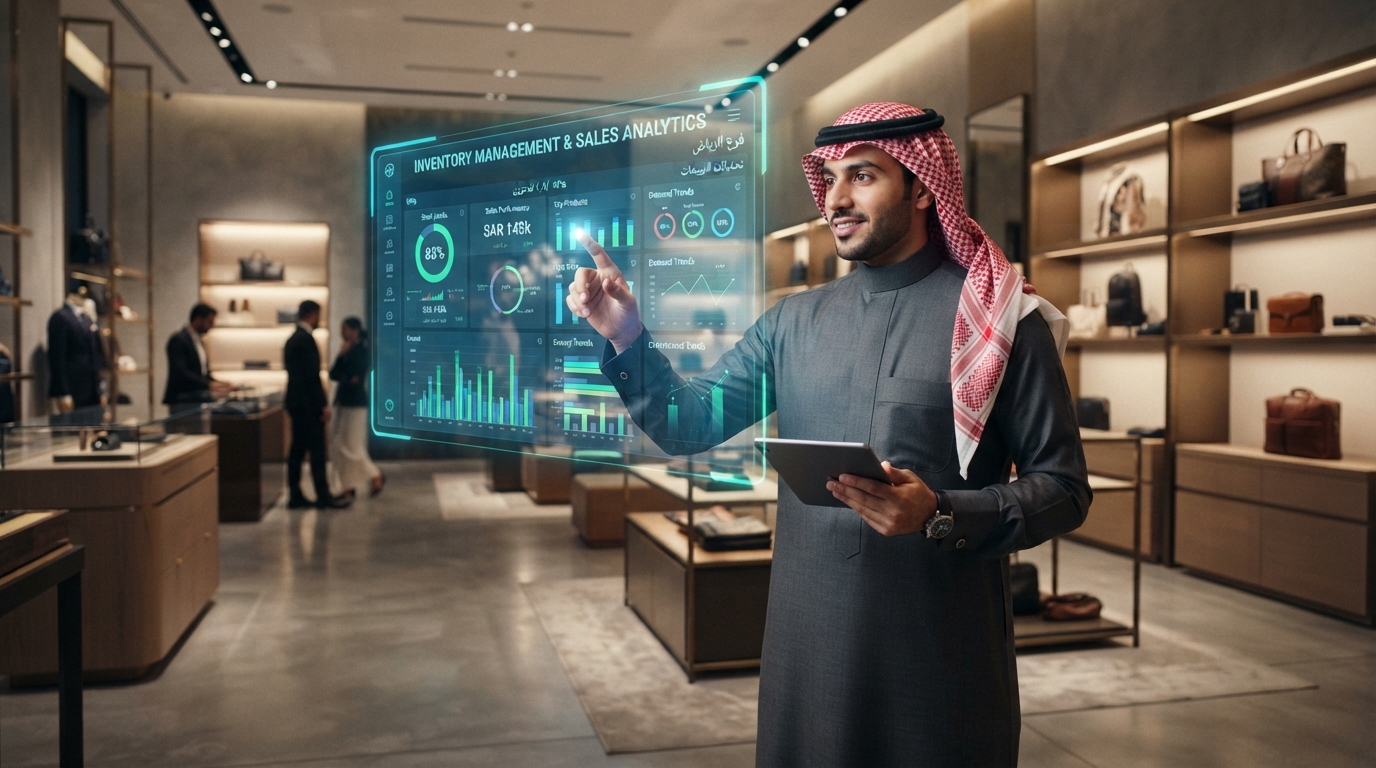
Retail businesses in Saudi Arabia run on speed and precision. A missed stock update, a delayed VAT reconciliation, or a point-of-sale system that doesn't talk to the warehouse can quietly erode margins long before anyone notices the pattern. For CEOs and CIOs managing multi-branch operations, this fragmentation isn't a minor inconvenience it's a structural risk to growth.
This is where a dedicated erp consultant retail engagement becomes valuable. Rather than forcing a retail business to adapt around generic software, the right consultant designs a retail erp system around how the business actually operates its branches, its supply chain, its compliance obligations, and its customers.
This article walks through what retail ERP consulting involves, the features that matter most for retail operations, and how Saudi retailers can approach the transition without disrupting day-to-day sales.
What Is Retail ERP Consulting?
Retail ERP consulting is the process of assessing, designing, and implementing an enterprise resource planning system tailored specifically to retail operations as opposed to a generic ERP built for manufacturing or services.
An erp consultant retail in Saudi Arabia typically evaluates:
- How inventory moves across warehouses, distribution centers, and individual stores
- How point-of-sale (POS) data feeds into accounting and reporting
- How the business currently handles Saudi-specific requirements, including ZATCA e-invoicing compliance
- Where manual processes spreadsheets, disconnected POS systems, standalone accounting software are creating bottlenecks or errors
The consultant's role is not simply to install software. It is to map the retailer's operational reality onto a system architecture that eliminates duplication and gives decision-makers accurate, real-time visibility.
As one provider working in this space, ITC's ERP system is built to manage everything from sales and procurement to HR and accounting, connecting easily with a client's existing systems and tailored to the nature of their business. That kind of tailoring is particularly relevant for retail, where sales velocity and inventory turnover are far higher than in most other sectors.
Key Features of a Retail-Focused ERP System
Not every ERP module matters equally to a retail business. The following capabilities tend to have the most direct impact on day-to-day retail performance.
1. Real-Time Inventory and Stock Visibility
Retailers need to know what's on the shelf, what's in the warehouse, and what's in transit — at the same moment, across every branch. A retail ERP consolidates this into a single source of truth, reducing overstocking and stockouts alike.
2. Integrated Point-of-Sale (POS) Connectivity
When POS systems operate independently from the back-office system, every sale requires manual reconciliation. A properly configured ERP connects POS data directly to inventory and financial records, removing that lag entirely.
3. Financial and Accounting Integration
Retail businesses handle high transaction volumes, multiple payment methods, and VAT obligations simultaneously. ITC's ERP system is designed to integrate securely with most popular accounting systems, which matters for retailers who already have accounting infrastructure in place and don't want to rebuild it from scratch.
4. Multi-Branch and Multi-Warehouse Management
For retailers operating across Riyadh, Jeddah, Dammam, or expanding regionally, the ERP needs to handle branch-level reporting alongside consolidated group-level views without requiring separate systems for each location.
5. Customizable Modules
Retail operations differ a fashion retailer's needs differ from a grocery chain's or an electronics retailer's. Customization of modules such as HR management, sales, and accounting allows the system to reflect the specific product mix, seasonality, and staffing structure of each retail business.
6. Data Security and Access Control
With customer payment data and transaction histories flowing through the system continuously, data protection is a baseline requirement rather than an optional add-on.
Contact us
Practical Use Cases
A multi-branch fashion retailer consolidating five store locations onto one system gains a single inventory view, allowing head office to shift stock between branches based on real demand rather than guesswork.
A grocery chain managing high-frequency, low-margin transactions benefits most from POS-to-accounting automation, since manual reconciliation at that transaction volume is simply not sustainable.
An electronics retailer with serialized inventory and warranty tracking needs an ERP that can manage product-level detail, not just aggregate stock counts.
A government-affiliated retail entity procuring goods through formal tender processes needs an ERP with strong audit trails and reporting that satisfies institutional compliance requirements.
In each case, the starting point is the same: a needs assessment before any system configuration begins.
Challenges and Best Practices
Retail ERP implementations fail more often from process issues than from technology issues. Common challenges include:
- Underestimating change management. Store staff and warehouse teams need training and a clear reason to trust the new system over familiar manual workarounds.
- Rushing the requirements analysis phase. Skipping this step leads to a system that technically works but doesn't match how the business actually operates.
- Poor data migration planning. Historical sales and inventory data needs to be cleaned and structured before migration, not after.
- Treating go-live as the finish line. Ongoing support and adjustment after launch is where most of the practical value gets realized.
Best practice is a phased rollout. A structured approach beginning with requirement analysis, followed by system development and customization, then testing and training, and finally launch with ongoing support reduces disruption to daily sales operations and gives the business time to adjust at each stage rather than absorbing the entire change at once.
Retail businesses in Saudi Arabia are operating in an environment where speed, accuracy, and compliance all matter simultaneously. A generic system, or a patchwork of disconnected tools, eventually becomes the constraint on growth rather than the support for it.
Working with an experienced erp consultant retail teams can trust one who understands both retail operations and the Saudi regulatory environment turns ERP from a software purchase into an operational asset. The result is a retail erp system that gives leadership real visibility, reduces administrative overhead, and scales alongside the business rather than holding it back.
Contact us
Frequently Asked Questions
What does an ERP consultant for retail actually do?
They assess current operations, identify inefficiencies across inventory, sales, and finance, and design an ERP system configuration that addresses those specific gaps — rather than applying a one-size-fits-all setup.
How long does a retail ERP implementation take?
Timelines vary based on business size and complexity, but implementations typically follow phases: requirement analysis, development and customization, testing and training, then launch with each phase adding to the overall timeline.
Can a retail ERP integrate with our existing accounting software?
In most cases, yes. A properly designed ERP is built to integrate securely with commonly used accounting systems rather than requiring a full replacement.
Is retail ERP only for large chains, or does it work for smaller retailers?
Customizable ERP systems can scale down as well as up smaller retailers benefit from modular configurations that avoid paying for unnecessary functionality.
How does retail ERP support Saudi VAT and e-invoicing compliance?
Retail ERP systems can be configured to generate compliant e-invoices and maintain the transaction records required under Saudi VAT and ZATCA regulations, reducing the manual compliance burden on finance teams.
What happens after the ERP system goes live?
Ongoing technical support and staff training continue post-launch to ensure the system is used effectively and adjusted as the business evolves.
Can the ERP handle multiple store locations separately and as a group?
Yes a properly configured retail ERP provides both branch-level reporting and consolidated group-level visibility from the same system.
What's the first step in starting a retail ERP project?
A needs analysis. Before any system is configured, the consultant needs a clear picture of current processes, pain points, and growth plans.
