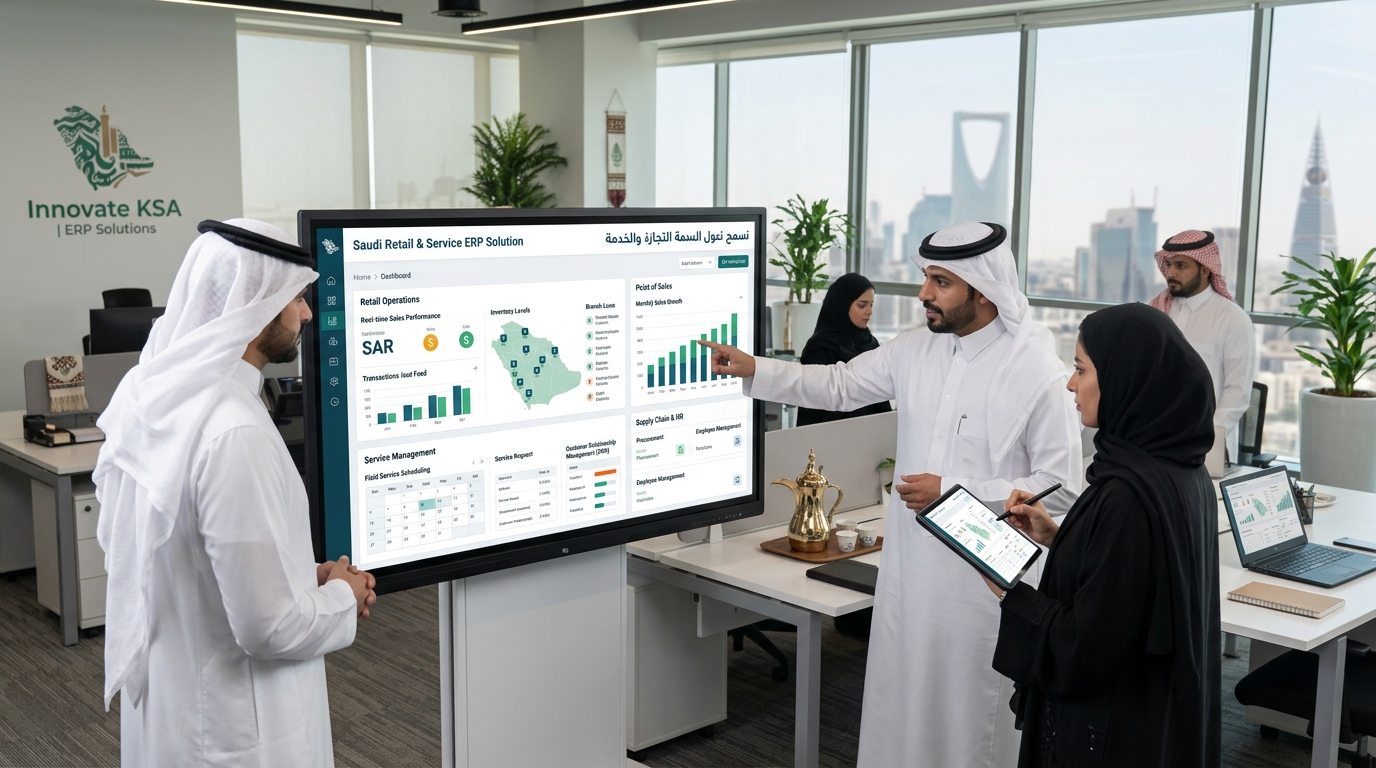
If your business in Saudi Arabia is still running on disconnected spreadsheets, manual approvals, and siloed departments you're not just losing time. You're losing money, visibility, and your competitive edge. The good news? ERP systems in Saudi Arabia are no longer reserved for large enterprises. Retail chains in Jeddah, service firms in Riyadh, and growing SMEs across the Kingdom are transforming how they operate and it starts with one smart decision.
Ready to modernize your operations?
What Is an ERP System and Why Does Saudi Arabia Need It Now?
An ERP (Enterprise Resource Planning) system is an integrated software platform that connects your core business functions finance, inventory, HR, procurement, sales, and customer service into one unified digital environment. Instead of chasing data across multiple tools, your entire operation works from a single source of truth.Saudi Arabia's business landscape is evolving at a remarkable pace. Vision 2030 has accelerated digital transformation across every sector, from retail and hospitality to logistics and professional services. Government-mandated compliance requirements including VAT reporting, Zakat filings, and e-invoicing (Fatoorah) have made it not just beneficial, but essential for businesses to adopt structured, automated systems.Companies relying on legacy software or manual processes are struggling to keep up. Those investing in ERP Saudi Arabia solutions are gaining a measurable operational edge.
Don't wait for compliance issues to force your hand. Act now.
The Real Cost of NOT Having an ERP System
Before we talk about what ERP can do, let's be honest about what the absence of one is costing you right now.
Without an integrated ERP system, your business likely faces:
- Data fragmentation Finance doesn't see what procurement ordered. Sales doesn't know what inventory is available. Everyone is working from different numbers.
- Manual reporting delays End-of-month reports take days instead of minutes. Decision-making is reactive, not strategic.
- Compliance gaps Fatoorah e-invoicing requirements and VAT regulations demand accuracy your spreadsheets simply can't guarantee.
- Scalability ceilings What works for a 10-person team collapses under the pressure of 50, 100, or 500 employees.
- Customer experience failures In retail and service industries, slow order processing, stock discrepancies, and billing errors directly damage your brand reputation.
The cost of inaction is far greater than the cost of implementation. Saudi businesses that have undergone ERP implementation in Riyadh and other major cities report dramatic reductions in operational overhead within the first year alone.
Calculate what inefficiency is costing you today
ERP for Retail Companies in Saudi Arabia: Beyond the Point of Sale
Retail in Saudi Arabia is undergoing a structural shift. Consumer behavior has changed. Omnichannel expectations seamless experiences across physical stores, e-commerce platforms, and social commerce demand a backend infrastructure that can keep up.
An ERP system for retail companies in Saudi Arabia does far more than manage your point-of-sale data. It connects every touchpoint of the customer journey:
Inventory & Supply Chain Intelligence
Real-time visibility into stock levels across all branches eliminates both overstocking and costly stockouts. Automated reorder triggers mean your shelves are never empty during peak seasons Ramadan, National Day, and Eid included.
Customer Relationship Management (CRM) Integration
Understanding purchase history, loyalty behaviors, and customer segmentation becomes possible when your ERP connects with your CRM layer. Personalized promotions and smarter customer retention strategies follow naturally.
Financial Consolidation Across Branches
Multi-location retail operators can consolidate financial reporting across all outlets in real time no more waiting for branch managers to submit monthly reports. Instant visibility. Instant decisions.
E-commerce & Marketplace Integration
Modern retail ERP solutions integrate directly with platforms like Salla, Zid, and major marketplaces keeping your online and offline inventory synchronized automatically.
Upgrade your retail operations with a system built to scale
ERP for Service Companies in Saudi Arabia: Structure That Drives Growth
Service-based businesses consultancies, IT firms, facilities management companies, healthcare providers, and professional services have different ERP needs than product-driven businesses. The currency isn't inventory; it's time, people, and project delivery.
An ERP system for service companies in Saudi Arabia addresses these unique dynamics:
Project & Resource Management
Assign the right people to the right projects, track utilization rates, and monitor project profitability in real time. No more guessing whether a project is on budget until the invoice goes out.
HR & Payroll Localization
Managing a diverse workforce with Saudi nationals, expatriates, and contractors requires a payroll engine that handles GOSI contributions, Iqama processing, end-of-service calculations, and Saudization (Nitaqat) compliance seamlessly.
Billing & Revenue Recognition
Service businesses often deal with milestone billing, retainer agreements, and complex contracts. ERP systems automate invoicing cycles, track payment status, and flag overdue accounts before they become cash flow problems.
Client Portal & Communication Logs
Some advanced ERP platforms include client-facing portals where project progress, documents, and approvals can be tracked elevating the professional experience you deliver.
Transform how your service firm operates get in touch today
What to Look for in an ERP Partner in Saudi Arabia
Choosing the right ERP system is one decision. Choosing the right implementation partner is another and arguably more important.
A failed ERP implementation doesn't just waste budget; it disrupts operations and erodes team confidence in technology adoption. The right partner brings:
- Deep local market knowledge Understanding Saudi business culture, regulatory requirements, and industry-specific workflows is non-negotiable.
- Proven implementation methodology Clear project phases, defined milestones, and transparent communication throughout the rollout.
- Post-implementation support Training, optimization, and ongoing technical support ensure your team actually uses the system to its full potential.
- Scalability planning Your business today is not your business in three years. The right ERP grows with you.
- Industry-specific customization A retail ERP and a service ERP are not the same thing. Beware of one-size-fits-all pitches.
At ITC, we have helped businesses across Saudi Arabia from Riyadh to Jeddah, from startups to established enterprises design, implement, and optimize ERP systems that actually deliver measurable ROI.
Let's build your ERP roadmap together contact ITC
The ERP Implementation Journey: What to Expect
Many business owners hesitate on ERP adoption because implementation feels overwhelming. Here's a realistic, simplified view of what the process looks like when done right:
Phase 1 Discovery & Scoping (2–4 weeks) Understanding your current processes, pain points, and business goals. Mapping the gap between where you are and where you need to be.
Phase 2 Solution Design (3–6 weeks) Configuring the ERP to match your specific workflows, integrations, and reporting needs. This is where customization happens.
Phase 3 Data Migration (2–4 weeks) Transferring historical data — customers, vendors, inventory, financial records — into the new system with rigorous accuracy checks.
Phase 4 Testing & Training (2–4 weeks) End-to-end testing in a sandbox environment, followed by hands-on user training for your team.
Phase 5 Go-Live & Hypercare Launch day — followed by intensive support to resolve any real-world issues quickly. Most businesses are fully operational within days.
Phase 6 Optimization & Growth The real ROI begins here. With data flowing cleanly across the business, you start making decisions based on facts, not gut feeling.
Start your ERP journey with the right partner
Frequently Asked Questions (FAQ)
What is an ERP system and why does my Saudi business need one?
An ERP integrates all your business functions into one platform, eliminating data silos and improving operational efficiency.
How long does ERP implementation in Riyadh typically take?
Most implementations take between 2 to 6 months depending on business size and complexity.
Is ERP suitable for small and medium businesses in Saudi Arabia?
Yes modern cloud ERP solutions are fully scalable and cost-effective for SMEs across all sectors.
Does ERP support Saudi compliance requirements like VAT and Fatoorah?
Yes localized ERP solutions include built-in modules for VAT, ZATCA e-invoicing, GOSI, and Zakat compliance.
What is the difference between ERP for retail and ERP for service companies?
Retail ERP focuses on inventory, supply chain, and POS integration; service ERP prioritizes project management, billing, and resource planning.
How do I choose the right ERP partner in Saudi Arabia?
Look for local market expertise, a proven implementation track record, and strong post-launch support capabilities.
Can ERP systems integrate with existing software we already use?
Yes most modern ERP platforms support API-based integration with accounting tools, e-commerce platforms, and CRM systems.
