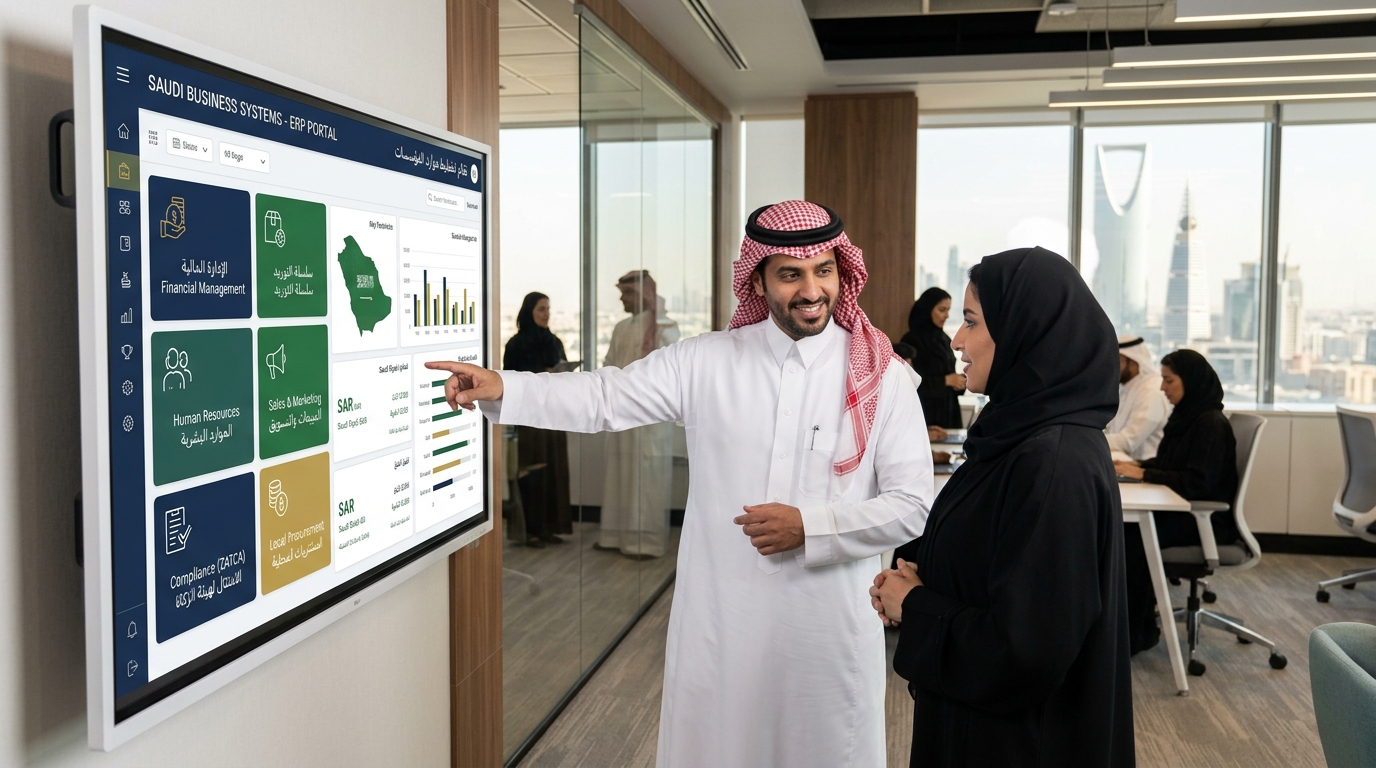
Most businesses in Riyadh don't fail because of bad products or weak teams. They fail because their operations are held together by disconnected spreadsheets, siloed departments, and software that was never designed to scale. If your company is growing and in Riyadh's market right now, the pressure to grow is relentless then the question isn't whether you need an ERP system. It's whether you can afford to wait any longer.
What ERP Systems Actually Do (And Why Riyadh Businesses Need Them Now)
ERP Enterprise Resource Planning is the central nervous system of your business. It connects finance, procurement, HR, inventory, sales, and operations into a single, unified platform. No more chasing updates across five different tools. No more end-of-month reconciliation nightmares. No more guessing where your margins are bleeding.
For businesses operating in Riyadh whether you're in retail, construction, logistics, healthcare, or professional services ERP systems in Riyadh offer something the local market has never needed more: clarity at speed.
Saudi Vision 2030 is accelerating everything. New sectors are opening. Competition is intensifying. Investors are expecting operational maturity. The businesses that thrive in this environment will be the ones that made the infrastructure decisions early.
Ready to future-proof your operations? Start here.
Why Growing Businesses in Riyadh Are Switching to ERP
Small and mid-sized businesses often resist ERP adoption because they associate it with enterprise complexity and enterprise-sized budgets. That assumption is outdated.
Modern ERP systems in Riyadh for growing businesses are modular, cloud-ready, and designed to scale with you not ahead of you. You implement what you need today, then expand as your business demands it. That might mean starting with financial management and inventory, then adding HR and CRM modules six months later.
The real cost isn't the software. It's operating without it.
Consider what growing businesses in Riyadh typically deal with without ERP:
- Inventory discrepancies that only show up during audits
- Finance teams spending days pulling together reports that should take minutes
- Sales staff working with outdated stock data and making promises operations can't keep
- HR managing employee records across multiple disconnected systems
Every one of these problems has a direct cost. ERP eliminates them systematically.
Don't let operational gaps limit your growth
ERP Solutions for Retail Companies in Riyadh
Retail is one of the sectors where ERP delivers its fastest, most measurable ROI and Riyadh's retail sector is one of the most dynamic in the region.
ERP solutions Riyadh retail operators depend on typically cover:
Real-time inventory management across multiple branches and warehouses no more stockouts at one location while another sits on excess inventory.
Integrated point-of-sale and back-office systems that give you live data on what's selling, what's not, and where your margins actually are.
Supplier and procurement management that automates purchase orders, tracks deliveries, and flags discrepancies before they become problems.
Customer loyalty and CRM integration that connects your front-end sales experience with back-end data, letting you personalise at scale.
For retail companies preparing to expand new branches, new product lines, franchise models ERP isn't a convenience. It's the operational prerequisite for scaling without chaos.
Explore ERP retail solutions built for Riyadh's market.
What ERP Implementation in Riyadh Actually Looks Like
One of the biggest reasons businesses delay ERP adoption is fear of the implementation process. That fear is understandable, but it's usually built on outdated information.
Professional ERP implementation Riyadh projects today are structured, phased, and designed to minimise disruption to your day-to-day operations. Here's what a competent implementation typically looks like:
Business Process Analysis
Before a single line of configuration is written, the implementation team maps your current workflows, identifies inefficiencies, and defines what the system needs to accomplish. This phase is where most ERP projects succeed or fail skipping it is how you end up with a system that doesn't fit your business.
System Configuration and Customisation
The ERP platform is configured to reflect your specific processes chart of accounts, approval workflows, inventory hierarchies, HR structures. In some cases, custom modules are developed for industry-specific requirements.
Data Migration
Your existing data customer records, vendor databases, financial history, inventory counts is cleaned, structured, and migrated into the new system. Data quality at this stage determines how useful your reporting will be from day one.
User Training and Testing
Department-level training ensures your team can actually use the system. Parallel testing runs the new system alongside the old one to validate accuracy before full go-live.
Go-Live and Post-Implementation Support
A managed go-live with dedicated support during the critical first weeks. Followed by ongoing optimisation as users identify refinements and the business evolves.
Done properly, ERP implementation is not a disruption. It's a transition.
Talk to our implementation team about your timeline.
The Role of an ERP Consultant in Riyadh
Choosing the right ERP platform is only half the equation. Choosing the right implementation partner is the other half and arguably the more important one.
An experienced ERP consultant Riyadh businesses trust brings three things that software alone cannot provide: industry context, technical depth, and the ability to translate business requirements into system design.
What separates a capable ERP consultant from the rest:
Vendor independence the best consultants recommend what fits your business, not what earns them the highest margin. They should be able to articulate clearly why a specific platform suits your industry, your size, and your growth trajectory.
Local market knowledge Saudi regulatory requirements, Zakat compliance, Arabic language support, integration with ZATCA's e-invoicing mandate, and HR structures aligned with local labour law are all non-negotiables. A consultant without this knowledge will cost you significantly in rework.
Post-implementation commitment implementation is where the relationship starts, not where it ends. The businesses that get the most value from ERP are the ones whose consultants remain engaged through optimisation cycles, user adoption challenges, and system upgrades.
At ITC, our ERP consulting practice in Riyadh is built around these principles. We work with businesses that are serious about operational transformation not just software installation.
Connect with an ERP consultant who understands your business.
ERP and Saudi Vision 2030: The Compliance and Competitiveness Angle
Businesses operating in Saudi Arabia are navigating a rapidly evolving regulatory environment. ZATCA's phased e-invoicing rollout, updated labour law requirements, Saudization targets, and VAT compliance demands are all placing new pressures on finance and HR teams.
Modern ERP systems are built to address these requirements natively. ZATCA-compliant e-invoicing, automated VAT calculations, localised payroll and GOSI integration, and audit-ready reporting are standard features in enterprise-grade ERP platforms deployed in the Saudi market.
Beyond compliance, Vision 2030's push toward digital transformation and private sector growth is creating an environment where operational efficiency is a competitive differentiator. The businesses that invest in ERP infrastructure now will be positioned to move faster, scale more reliably, and attract the kind of investment and partnership opportunities that the Vision 2030 economy is generating.
Position your business for Vision 2030. Act now.
Choosing the Right ERP Platform for Your Riyadh Business
The ERP market offers dozens of platforms across every price point and capability tier. The most commonly deployed solutions in the Saudi market include SAP Business One, Oracle NetSuite, Microsoft Dynamics 365, and Odoo each with distinct strengths depending on business size, industry, and complexity.
Selecting the right platform requires an honest assessment of:
- Your current operational scale and projected growth over 3–5 years
- The specific functional modules your business needs at go-live vs. future phases
- Your internal IT capability and how much ongoing technical management you can sustain
- Integration requirements with existing tools POS systems, e-commerce platforms, logistics providers
- Total cost of ownership, not just license fees
This is exactly the analysis a qualified ERP consultant should provide before any platform decision is made. At ITC, we begin every engagement with a detailed needs assessment that results in a clear, justified platform recommendation not a sales pitch.
Get an honest ERP platform assessment for your business.
Frequently Asked Questions
What is ERP and why does my Riyadh business need it?
ERP unifies your business operations finance, HR, inventory, sales into one system, eliminating inefficiency and giving you real-time visibility.
How long does ERP implementation take in Riyadh?
Typically 3 to 6 months for mid-sized businesses, depending on complexity and data readiness.
What is the cost of ERP implementation in Riyadh?
Costs vary widely by platform, business size, and scope a proper consultant assessment is the only way to get an accurate figure.
Which ERP system is best for retail companies in Riyadh?
It depends on your scale and integration needs SAP, Dynamics 365, and Odoo are all strong options with different trade-offs.
Is ERP suitable for small and growing businesses in Riyadh?
Yes modern ERP platforms are modular and scalable, designed to grow with businesses from SME stage upward.
Does ITC provide post-implementation ERP support in Riyadh?
Yes ITC's ERP practice includes ongoing support, optimisation, and system evolution well beyond go-live.
Are ERP systems in Riyadh compliant with ZATCA e-invoicing requirements?
Enterprise-grade ERP platforms deployed in Saudi Arabia include native ZATCA compliance features as standard.
